Food Waste Is Costing You $1,500 a Year — Here Is How to Cut It in Half
There is a grocery expense that never appears on any receipt, never shows up as a line in your budget, and quietly costs the average family more than their streaming, coffee, and phone bills combined: the food you throw away. Roughly one grocery bag in three never gets eaten. This article breaks down the real numbers behind household food waste, the five habits that cause most of it, why date labels trick you into tossing good food — and how your own purchase history can show you exactly where the money is leaking.
Track your own grocery prices - scan a receipt, free.

A third of what you buy never gets eaten
The numbers on food waste are so large they sound made up. The FDA estimates that 30–40% of the US food supply goes uneaten. At the household level, researchers at Penn State found that the average American household wastes almost a third of the food it acquires — roughly $1,800 per year at the time of the study. The USDA's more conservative figure puts it at about $1,500 a year for a family of four.
Pick whichever number you like. Even the low end means this: for every three grocery bags you carry into the house, one goes in the trash. If someone stole a full bag of groceries from your car every third trip, you would call the police. When it happens in your own kitchen, you do not even notice.
Why food waste never feels like overspending
Food waste is the one grocery leak that never appears on any receipt. You paid for the spinach twelve days ago. The transaction was small, the card tap was painless, and the register total looked reasonable. By the time the spinach turns to liquid in the crisper drawer, the money is long spent and mentally filed under "groceries" — a responsible category, not a wasteful one.
This is the same mechanism that makes grocery budgets fail in general: dozens of small, delayed, unmonitored decisions that never trigger the alarm a single large purchase would. Nobody throws away $1,500 of food in one dramatic moment. They throw away $4 of wilted herbs, $3 of sour milk, and $6 of leftovers — 350 times a year.
Where household food waste actually comes from
Restaurants and supermarkets get most of the media attention, but ReFED's data shows households are the single largest source of food waste in the US — bigger than any commercial sector. And within the home, the waste comes from a handful of predictable habits:
- Shopping without checking what you already have. The second bag of shredded cheese, the third half-used jar of pesto. Duplicates are pure waste in slow motion.
- Buying for the week you wish you had. Seven dinners of ingredients for a week that realistically contains one takeout night, one leftovers night, and one "cereal is fine" night.
- Falling for bulk math. The 2 kg tub is cheaper per unit than the 500 g one — but only if you finish it. A bulk deal where a third spoils is more expensive than the small size, as we covered in our store price comparison.
- Cooking family-size portions for two people. Leftovers are only savings if they get eaten, and most refrigerated leftovers have a three-day window before nobody wants them.
- Treating the fridge as storage instead of a queue. Food pushed to the back is food you have already decided to throw away — you just have not done it yet.
Date labels: the most expensive misunderstanding in your kitchen
A surprising share of household waste is food that was still perfectly good. "Best if used by," "sell by," and "use by" are quality dates, not safety dates — with the single exception of infant formula, none of them are federally regulated safety deadlines. Yogurt does not become dangerous at midnight on the printed date. Eggs last weeks past their carton date. Hard cheeses can simply be trimmed.
The USDA's guidance is to judge by storage time and your senses, not the label. Every unopened item tossed on its printed date is money thrown away out of caution the manufacturer never asked for.
Five fixes that do not require meal-prepping every Sunday
Most food waste advice assumes you want to become a person who batch-cooks in labeled containers. You do not have to. These five changes fit inside your existing routine:
- Shop your fridge first. Before writing a list, spend two minutes looking at what is already there. Build the first two dinners of the week around what needs using.
- Buy for five dinners, not seven. Life fills the gap. If you genuinely run out, a small mid-week top-up shop wastes far less than a spoiled surplus.
- Right-size the bulk deals. Unit price only counts if the food gets eaten. Be honest about your household's actual consumption speed before the warehouse-club tub goes in the cart.
- Freeze on day two, not day five. The freezer is a pause button, but most people press it only when food is already on the edge. Bread, meat, cooked rice, even milk — freeze while it is still good.
- Create an "eat me first" shelf. One designated spot at eye level for anything close to its date. It turns the fridge back into a queue.
Your receipts already know what you waste
Here is the part almost nobody does: compare what you buy against what you actually consume. You do not need to weigh your trash. Your purchase history does the work, because waste shows up as a pattern of repeat purchases that outpace consumption.
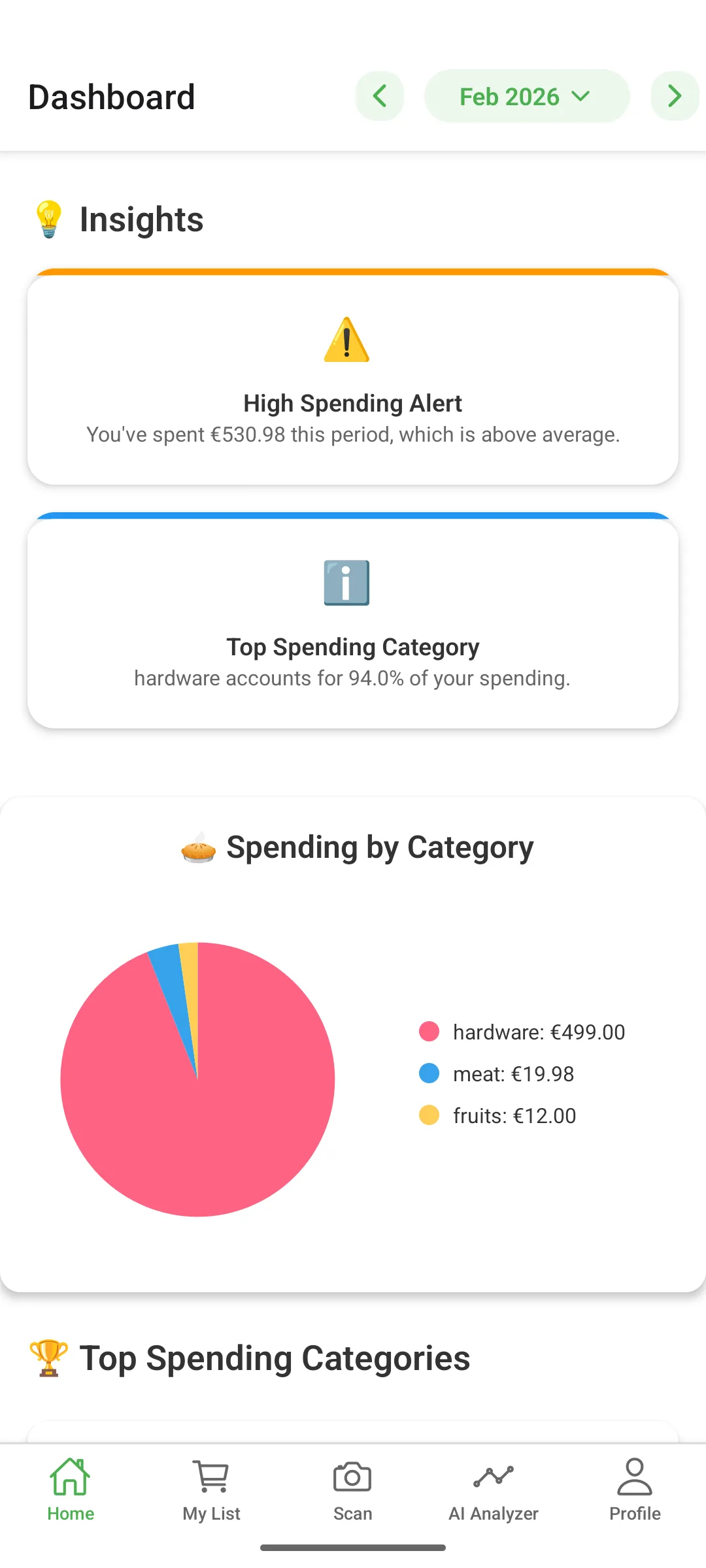
If a receipt scanner app shows you bought bagged salad on all of your last six shopping trips, ask the honest question: did you eat six bags of salad? If your spending tracker shows $80 a month in a category you mostly throw away, that is not a grocery cost — it is a subscription to your own trash can. Purchase frequency data makes over-buying visible in a way your memory never will, the same way it exposes the other overspending patterns that do not require coupons to fix.
Once you can see the pattern, the fix is usually trivial: buy one bag instead of two, or switch to a longer-lasting alternative. The insight costs 15 seconds of scanning per receipt.
What cutting your waste in half is worth
You will not get to zero waste, and you do not need to. Halving is realistic within a month or two of paying attention, and the math is compelling:
- Family of four: roughly $750 a year back — about $62 a month, or three to four weeks of free groceries per year.
- Couple: roughly $400–500 a year back with essentially no lifestyle change.
- As a percentage: if you waste the average ~30% and cut it to 15%, your effective grocery prices just dropped 15% — more than most loyalty programs, coupons, or store-switching strategies deliver, combined.
There is an environmental bonus too: the EPA reports that food is the single largest category of material in US landfills. But you do not need to care about that for the math to work. Food waste is the rare budget fix where the money was already yours — you just have to stop carrying it to the curb.
Frequently asked questions
How much food does the average family waste per year?
The USDA estimates a family of four loses about $1,500 per year to uneaten food, while Penn State research found the average household wastes nearly a third of the food it acquires — closer to $1,800 annually. Either way, roughly one grocery bag in three never gets eaten.
Is food safe to eat after the printed date?
Usually, yes. "Best if used by," "sell by," and "use by" dates indicate peak quality, not safety, and none are federally regulated safety deadlines except on infant formula. Judge food by proper storage time, appearance, and smell rather than the printed date alone.
Which foods get wasted the most?
Perishables dominate household waste: fresh produce (especially bagged salads and herbs), dairy, bread, and cooked leftovers. These are also the categories where small habit changes — buying less per trip, freezing earlier — recover the most money.
Can tracking receipts really reduce food waste?
Yes, indirectly but effectively. A receipt scanner shows your purchase frequency per item and category, which makes over-buying visible: if you purchase an item far more often than you finish it, that pattern appears in your history. Users typically spot two or three chronic over-buys within the first month of scanning.
Put this into practice in seconds
Scan your receipts and let GroceryTracker Pro track every store, category, and price for you - free to start.